

Green Cleaner: Spider Mite Spray That Kills Mites and Their Eggs on Contact
Green Cleaner is a concentrated contact spray for spider mites, broad mites and russet mites. It also controls aphids, thrips, whiteflies and fungus gnats, and it's labeled for powdery mildew. It's a FIFRA 25(b) minimum-risk pesticide built on organically grown soybean oil and sodium lauryl sulfate. Use it on all food and feed crops from clone to harvest: 0-day pre-harvest interval, 0-hour re-entry once dry.

Green Cleaner Testimonials
Complete Plant Protection
Kills mites & their eggs on contact
Labeled for powdery mildew
No neem needed
For Indoor & Outdoor Use
Soybean oil grown organically
0-hr re-entry once dry
Contact spray for your IPM rotation
0-day PHI
All food & feed crops
Use from Start to Harvest
Powdery mildew prevention (½ oz/gal)
Kills on Contact
No Sulfur Needed
Surfactant built in
Kills spider mites & eggs on contact
Kills Soft bodied Insects

Grow it
•
Protect it
•
Grow it
•
Grow it • Protect it • Grow it •

For Retail / Wholesale
Available in bulk through our distributors. Ideal for retail and wholesale. Order in bulk for superior value.

Become a Distributor
Join our network as a national distributor for Green Cleaner and expand your product line with a trusted, natural pest control option.

Commercial Accounts
Growing commercially? Compare your cost per finished gallon, and ask about 15 and 55 gal drums (special order): (831) 757-4733 or info@centralcoastgarden.com.

Label Facts at a Glance
Active ingredients: Soybean oil* 39% · Sodium lauryl sulfate 19%
Inert ingredients: 42%: water, isopropyl alcohol, sodium citrate, citric acid
Regulatory: Exempt from EPA registration under FIFRA 25(b) as a minimum-risk pesticide. Registered in Florida (C0612001) and Vermont (VT#65353)
Crops: For use on all food & feed crops
Pre-harvest interval: 0 days. Use up to harvest
Re-entry: 0 hours. Re-enter once the spray is dry; no PPE needed to re-enter
Mix: ½–2 oz per gallon of water only
Yield: 1 gallon of concentrate makes 64–256 gallons of spray
*Soybean oil grown organically.
Some states require registration of 25(b) products. Confirm availability in your state with CCGP or your distributor. Always read and follow the label on the container you use. Re-entry, shelf-life and mixed-solution guidance are from CCGP, not label text.
How Green Cleaner Works
Green Cleaner is a contact spray. Its soybean oil and sodium lauryl sulfate coat soft-bodied pests and mite eggs, disrupting their breathing and drying them out. Because it acts physically on contact rather than through a single biochemical target, it fits naturally into the contact-spray slot of an IPM rotation. Pair it with scouting, sanitation, quarantine of new plants, and other modes of action.
Green Cleaner is soybean-oil based, with a surfactant built in. You don't need neem oil, sulfur, or an added surfactant.
Benefits
Minimum-risk actives
Soybean oil and sodium lauryl sulfate; FIFRA 25(b) exempt.
Fits IPM
A contact spray for your rotation.
Know your cost
Cost-per-finished-gallon calculator on our Commercial page.
Labor-friendly
0-hr re-entry once dry, 0-day PHI.
One concentrate, three rates
½, 1 and 2 oz per gallon.
Multiple targets
Mites and their eggs, aphids, thrips, whiteflies, fungus gnats, powdery mildew.
-
![Green Cleaner mite control spray bottle, 2 fl oz, with label showing instructions and warnings.]()
Green Cleaner
2oz
-
![Green Cleaner insecticide bottle for mites, 8 fl oz]()
Green Cleaner
8oz
-
![Green Cleaner 32 fl oz bottle, kills mites and eggs, orange and green label, directions and safety information included.]()
Green Cleaner
32oz
-
![Bottle of Green Cleaner pest control solution, 1 gallon, labeled for killing mites and eggs on contact, Central Coast Garden Products.]()
Green Cleaner
1 Gallon
-
![A 2.5-gallon container of Green Cleaner, a concentrated solution for killing mites and their eggs on contact. The label features usage directions, application instructions, and safety warnings. The product is marked as suitable for organic production and is intended for use on plants.]()
Green Cleaner
2.5 Gallon

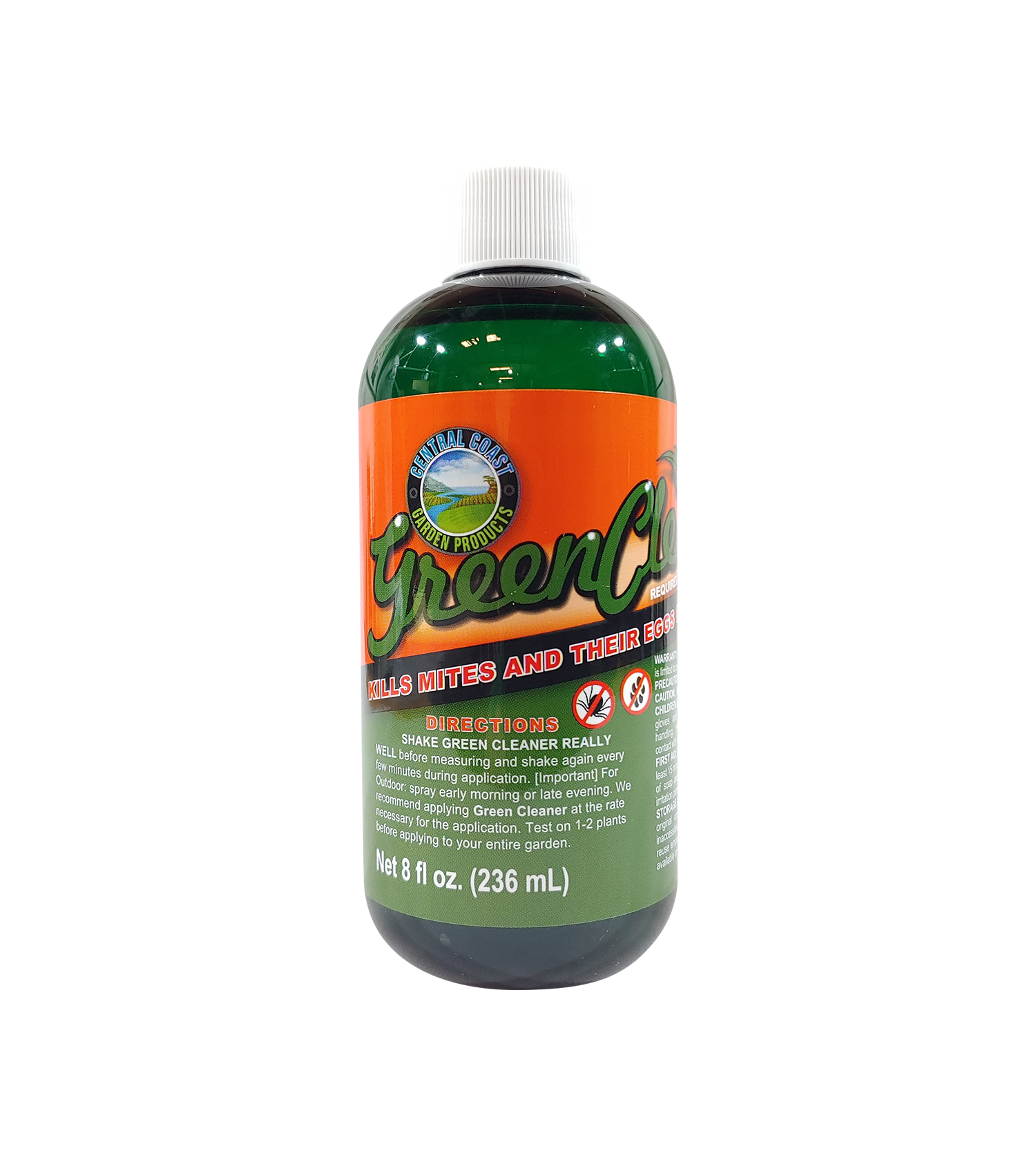


Green Cleaner kills mites and their eggs, aphids, thrips, whiteflies and fungus gnats on contact, and is labeled for powdery mildew.
-

Spider Mites
Russet & Broad Mites
-

Aphids
-

Thrips
-

White Flies
-

Fungus Gnats
-

Larvae & Eggs

Directions / Application
Directions / Application
Mixing Chart: Spray Bottle to 100-Gallon Tank
Concentrate needed per sprayer. 1 Tbsp = ½ fl oz ≈ 15 mL; 1 fl oz = 29.6 mL; 128 fl oz = 1 gal.
1-qt spray bottle (0.25 gal of water)
½ oz/gal (preventative, powdery mildew, clones, late harvest): 0.125 fl oz (4 mL; ¾ tsp)
1 oz/gal (normal): 0.25 fl oz (7 mL; 1½ tsp)
2 oz/gal (heavy): 0.5 fl oz (15 mL; 1 Tbsp)
1-gal hand sprayer (1 gal of water)
½ oz/gal (preventative, powdery mildew, clones, late harvest): 0.5 fl oz (15 mL; 1 Tbsp)
1 oz/gal (normal): 1 fl oz (30 mL; 2 Tbsp)
2 oz/gal (heavy): 2 fl oz (59 mL; 4 Tbsp = ¼ cup)
2-gal pump sprayer (2 gal of water)
½ oz/gal (preventative, powdery mildew, clones, late harvest): 1 fl oz (30 mL; 2 Tbsp)
1 oz/gal (normal): 2 fl oz (59 mL; ¼ cup)
2 oz/gal (heavy): 4 fl oz (118 mL; ½ cup)
4-gal backpack (4 gal of water)
½ oz/gal (preventative, powdery mildew, clones, late harvest): 2 fl oz (59 mL; ¼ cup)
1 oz/gal (normal): 4 fl oz (118 mL; ½ cup)
2 oz/gal (heavy): 8 fl oz (237 mL; 1 cup)
25-gal tank (25 gal of water)
½ oz/gal (preventative, powdery mildew, clones, late harvest): 12.5 fl oz (370 mL)
1 oz/gal (normal): 25 fl oz (739 mL)
2 oz/gal (heavy): 50 fl oz (1.48 L; 0.39 gal)
50-gal tank (50 gal of water)
½ oz/gal (preventative, powdery mildew, clones, late harvest): 25 fl oz (739 mL)
1 oz/gal (normal): 50 fl oz (1.48 L; 0.39 gal)
2 oz/gal (heavy): 100 fl oz (2.96 L; 0.78 gal)
100-gal tank (100 gal of water)
½ oz/gal (preventative, powdery mildew, clones, late harvest): 50 fl oz (1.48 L; 0.39 gal)
1 oz/gal (normal): 100 fl oz (2.96 L; 0.78 gal)
2 oz/gal (heavy): 200 fl oz (5.91 L; 1.56 gal)
Fill the tank about halfway with water, start agitation, add the measured Green Cleaner (shaken well), then top up with water. Keep agitating while spraying and use the mix within 24 hours.
Spray volume per acre isn't set by the label. Calibrate your sprayer, then multiply your gallons by the rate. See our commercial guide or call us for help planning a program.
Sizes, Coverage & Where to Buy
2 oz: makes 1–4 gal · MSRP $9.99
8 oz: makes 4–16 gal · MSRP $29.99
32 oz: makes 16–64 gal · MSRP $89.99
1 gal: makes 64–256 gal · MSRP $249.99
2.5 gal: makes 160–640 gal · MSRP $449.99
15 gal drum: makes 960–3,840 gal · Special order: call (831) 757-4733 or email info@centralcoastgarden.com
55 gal drum: makes 3,520–14,080 gal · Special order: call (831) 757-4733 or email info@centralcoastgarden.com
Find Green Cleaner near you
Green Cleaner is sold through retail and wholesale distributors nationwide. Use the Distributor buttons on this page.
Commercial growers
Running a greenhouse, nursery, farm or cultivation facility? Compare your cost per finished gallon and ask about 15 and 55 gallon drums (special order). Call (831) 757-4733 or email info@centralcoastgarden.com.
Storage & Shelf Life
Sealed in its original packaging: no expiration date.
Once opened: use within 1 year.
Mixed with water: use within 24 hours.
Store only in the original container in a cool, dry place, out of reach of children and pets. Do not reuse the empty container.
Precautions
CAUTION. Keep out of reach of children and animals. Harmful if swallowed. Avoid contact with eyes, skin or clothing. Wear gloves and protective eyewear when handling the concentrate. First aid: If in eyes, flush with water for at least 15 minutes. If on skin, wash with plenty of soap and water. Get medical attention if irritation persists. Keep spray and rinse water out of drains and waterways. Not for use in aquaponic systems.
Green Cleaner FAQ
1. What does Green Cleaner kill?
Green Cleaner kills mites and their eggs on contact, including spider, broad and russet mites. It also controls aphids, thrips, whiteflies and fungus gnats, and it's labeled for powdery mildew. Repeat applications are required.
2. How much Green Cleaner do I mix per gallon?
½ oz (15 mL) per gallon for prevention and powdery mildew, 1 oz (30 mL) for normal infestations, and 2 oz (60 mL) for heavy broad, russet or spider mite pressure. Never exceed 2 oz per gallon. Mix with water only.
3. How often should I spray?
Heavy infestations: 2 oz/gal on day 1, 1 oz on day 2, ½ oz on day 3 if needed. Normal infestations: 1 oz/gal, then ½ oz the next day (the label allows 1 oz/gal 2–3 times a week). Prevention: ½ oz/gal once or twice a week.
4. Can I use Green Cleaner up to harvest?
Yes. Green Cleaner is for use on all food and feed crops and has a 0-day pre-harvest interval, so it can be used up to the day of harvest. In late flower, use ½ oz/gal and avoid spraying directly into flowers.
5. What is the re-entry interval?
0 hours. Re-enter once the spray has dried; no protective gear is needed for re-entry. Wear gloves and eye protection when handling the concentrate.
6. What are the active ingredients?
Soybean oil (39%, grown organically) and sodium lauryl sulfate (19%). Inert ingredients (42%) are water, isopropyl alcohol, sodium citrate and citric acid. Green Cleaner is soybean-oil based, so no neem oil or added surfactant is needed.
7. Is Green Cleaner EPA registered?
Green Cleaner is a minimum-risk pesticide exempt from EPA registration under FIFRA section 25(b). It is registered in Florida (C0612001) and Vermont (VT#65353). Some states require registration of 25(b) products, so confirm availability in your state with CCGP or your distributor.
8. Is Green Cleaner organic?
The soybean oil in Green Cleaner is grown organically. Green Cleaner is not represented as certified organic or OMRI Listed, so check with your certifier before using it in a certified organic program.
9. When should I spray?
Out of strong light: early morning or late evening outdoors, or at lights-off indoors. Leaves should be dry before strong light returns. Test on 1–2 plants before treating the whole crop.
10. How long does Green Cleaner last?
Sealed in its original packaging it has no expiration date. Once opened, use within 1 year. Use mixed spray within 24 hours. Store cool and dry in the original container, out of reach of children and pets.
11. Can I mix Green Cleaner with other products?
No. Mix Green Cleaner with water only. You can rotate it with other IPM products on different days.
12. Can I use it in aquaponics?
No. Green Cleaner can harm the beneficial life an aquaponic system depends on.
13. Where can I buy Green Cleaner?
Buy 2 oz to 1 gal online, or find retail and wholesale partners on our distributors page. For 2.5 gal and 15 or 55 gal drums (special order), or commercial pricing, call (831) 757-4733 or email info@centralcoastgarden.com.
Application Rates & Schedules
Heavy infestation: 2 oz (60 mL) per gallon. Broad & russet mites (also severe spider mite or aphid outbreaks).
Website step-down: Day 1: 2 oz/gal · Day 2: 1 oz/gal · Day 3: ½ oz/gal if needed.
Label: 2 oz/gal, 2–3 days straight.
Normal infestation: 1 oz (30 mL) per gallon. Spider mites, aphids, thrips, whiteflies, fungus gnats.
Website step-down: Day 1: 1 oz/gal · Day 2: ½ oz/gal.
Label: 1 oz/gal, 2–3 times a week.
Preventative / maintenance & powdery mildew: ½ oz (15 mL) per gallon. Also fungus gnats and whiteflies.
Once or twice a week. Label: 1–2 times a week.
Rooted clones & cuttings: ½ oz (15 mL) per gallon. As needed for prevention.
Late harvest / late flower: ½ oz (15 mL) per gallon. Targeted sprays. Avoid spraying directly into flowers.
Never exceed 2 oz per gallon. In flower, don't go above 1 oz per gallon.
How to Spray Green Cleaner
Test first. Spray 1–2 plants and check them after 24 hours before treating everything.
Shake the bottle really well. Measure, then shake or agitate the sprayer every few minutes while you spray.
Mix: Water first, then Green Cleaner. Water only: no nutrients, oils or other pesticides.
Spray out of strong light: early morning or late evening outdoors, or at lights-off indoors. Let leaves dry before light hits them.
Saturate: cover the whole plant, especially leaf undersides and new growth. For fungus gnats and fallen pests, also spray the pots and top layer of soil or media.
Use the mix within 24 hours.
Repeat on schedule, and keep scouting. Remove and bag heavily infested leaves first, quarantine new plants, and if you can, run the room near 65°F to slow mite life cycles.
Directions by Plant Type
Fruit trees & orchards: Wet the whole canopy, including interior leaf undersides and new shoots, early morning or late evening. Mites: 2 → 1 → ½ oz/gal over 3 days. Aphids, thrips, whiteflies: 1 oz/gal, 2–3×/week. Powdery mildew prevention: ½ oz/gal, 1–2×/week. 0-day PHI.
Vegetables: Cover both leaf surfaces, stems and growing tips (broad mites at the tips; tomato russet mites from the lower stem up). Same three rates. Peppers can be more sensitive than tomatoes, so test at 1 oz/gal first.
Berries: Aim into strawberry crowns and both sides of cane and blueberry rows. Spider mites: 1 oz/gal, 2–3×/week. Powdery mildew: ½ oz/gal, 1–2×/week. Avoid spraying open blooms while bees are working.
Herbs & leafy greens: Fine, even mist on both sides of tender leaves; start at ½–1 oz/gal. Spray in the evening and rinse produce before eating, as with any spray. 0-day PHI.
Ornamentals & houseplants: Use a 1-quart bottle: 1½ tsp for infestations (1 oz/gal) or ¾ tsp for prevention (½ oz/gal). Spray leaf undersides plus the pot and top of the potting mix for fungus gnats. Keep out of direct sun until dry.
Greenhouse, shade house & nursery: Spray benches, pots, media surface and under benches (fungus gnats). Thrips, aphids, whiteflies, fungus gnats: 1 oz/gal, 2–3×/week. Prevention and propagation: ½ oz/gal, 1–2×/week. Time sprays around biocontrol releases.
Indoor grow rooms: Lights-off only, dry before lights-on. Clones ½ oz/gal; veg up to 2 oz/gal for heavy mites; flower no more than 1 oz/gal; late harvest ½ oz/gal, targeted. Not for aquaponics.
Outdoor fields: Scout, then spot-treat hot spots and edges early morning or late evening. Use nozzles that reach leaf undersides. Same rates and schedules; calibrate your spray volume (typical 50–100+ gal/acre, verify for your crop).
Green Cleaner Resources